T
Zurück zur Liste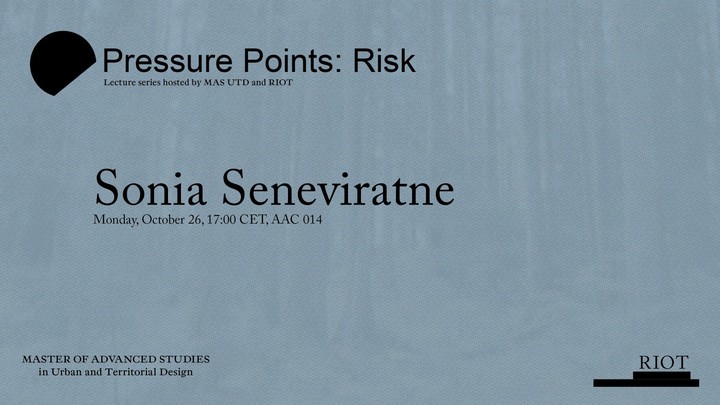
bildungKostenlos
Pressure Points: Risk - Sonia Seneviratne / RIOT, MAS UTD
Datum & Uhrzeit
Montag, 26. Okt. 2026
16:00 – 18:00
Ort
AAC 0 14
Lausanne, VD
Veranstalter
RIOT, MAS UTD
Beschreibung
Speaker: <a href="https://usys.ethz.ch/en/people/profile.seneviratne.html"><u>Sonia Seneviratne</u></a> is a Full Professor in Land-Climate Dynamics at ETH Zurich, with a focus on climate science and environmental physics. She conducts research on climate extremes such as droughts, land-climate processes, and human-induced climate change, based on climate modelling and data analyses. Listed among the Highly Cited Researchers of Web of Science (Clarivate) since 2014, she was a Coordinating Lead Author and Lead Author on several reports of the Intergovernmental Panel on Climate Change (IPCC), including the Special Report on Extreme Events, the Special Report on Global Warming of 1.5°C, and the Sixth Assessment Report in 2021. Seneviratne has received the Macelwane Medal of the American Geophysical Union in 2013 and the Hans-Oeschger Medal of the European Geosciences Union. Since July 2023, she serves as IPCC Working Group I Vice-Chair for the seventh assessment cycle (2023–2030). Her most recent contribution, published in June 2026, is the release of MESMER v1.0.0, an open-source climate model emulator she helped develop as part of her research group. It reproduces the spatial climate patterns of complex Earth System Models, including temperature and several climate-extreme indicators, making detailed climate information accessible to the wider research community.
Organiser: RIOT, MAS UTD
<p>“To emphasize (...) dubious uses of risk is perverse, a dirty way of talking about a<br>
clean scientific subject”<br>
Mary Douglas, <em>Risk and Blame,</em> 36.<br>
<br>
As the baseline condition of so many territories shaped by extractive industries, administrative delay, and climatic instability, risk is prevalent. Yet ecological risk—pollution, fires, floods, heatwaves, droughts—is still presented as problems to be solved rather than conditions to be inhabited. This also speaks to an outsourcing of risk through externalized consequences of spatial injustice. Banks, developers, mater